Smart Phone Users-Tap the 3 lines directly below for the navigation/site menu.
Looking to sell your Cybis? Smart Phone users expand the menu and go to Contact. Desktop/Tablet users go to Contact below in the navigation options.

Smart Phone Users-Tap the 3 lines directly below for the navigation/site menu.


Most collectors familiar with the porcelain arts have heard the name Laszlo Ispanky. This is for good reason. Ispanky's personal story is one of inspiration, profound patriotism and tremendous success as an artist and a man who contributed valuably to the nation's artistic history. He affiliated with Cybis at exactly the right time to contribute toward the studio's success in the 1960's. Marylin Kozuch-Chorlton, owner of Cybis and Artistic Director, certainly recognized the potential in Ispanky's work. With the suicide deaths of previous owners Boleslaw (1957) and wife Marja (1958), the studio was in need of new designs to distinguish it from the competition. Several of Ispanky's early works were purchased shortly after his arrival in the U.S. when he was a freelance artist. Wendy, Peter Pan, Thumbelina and Tinkerbell along with the impressive Madonna with Bird were snapped up and quickly entered in production as Cybis sculptures. This was a well calculated move for Cybis. They had been reinventing the studio and completing the transition from fine china to porcelain. They were gradually retiring production using commercially purchased molds in favor or unique designs. While works were also being purchased from other freelance artists, like Harry Burger, Ispanky's flexible talent offered many options for new designs.
Ispanky was hired to be the Master Sculptor and Chief Designer for Cybis. He was prolific in this position from the beginning and left a treasure trove of work the studio was still using for new introductions years after his departure. Ispanky was unlike any sculptor of his time. As attendees to any of his gallery events will attest, he could begin with a lump of clay and in moments transform it into a spectacular design. His vision for one piece may have required his sole attention through completion. Lesser pieces were designed, created and handed off to understudies for final touches. As the "Master Sculptor" Ispanky could make a basic design and then, as "Chief Designer", assign it to one of the talented women hired to do finishing work for completion under his watchful eye. These employees would smooth surfaces and incorporate detail where needed. One might finely sculpt tedious work like the chainmail on a knight's armor while another would add lace and hand made roses to "Cybis-ize" the final look. Some of these women would later aspire to create designs for the studio themselves, something they would have been far less able to do had they not received valuable career shaping guidance from Ispanky during his tenure with Cybis. Laszlo had the creative ability to produce numerous sculptures in a week's time. When a design moved into the development process, a unique design number was assigned. Today's list of Cybis design numbers has dozens of blank lines from this period and it's not known what these items were. It is assumable some, if not most or all, were Ispanky designs.
Merchants selling both Cybis and Ispanky, who were familiar with both studios, often said the first 80-90 pieces of Cybis were Laszlo's designs. In reality, that number was likely to have been greatly understated. However, existing marketing material from that era is minimal. Many items released were only briefly available and are yet to be "re-documented". They will be added here as found! Anyone researching this issue may determine 40 or so sculptures from the 1960's pricelists and catalogs are Ispanky's creations. Using extant marketing material is only a partial approach toward identifying ispanky sculptures created during the six year period of his highly prolific output. Such an approach is flawed and requires review.
At the point Ispanky was hired in 1960, Cybis was reintroducing itself, for the third time. In the early 1950's it was a production company selling mostly religious content made of fine china. About 1956, the transition began toward porcelain and redesigning many of the existing sculptures with a fresh look. The studio began purchasing designs from freelance artists, including Ispanky! By 1960, the "new" company was being promoted as a Porcelain Art Studio and not just a company selling porcelain decorative wares. When merchants said early Cybis pieces were Ispanky designs, they were referring to those designs introduced for the Cybis company's most recent iteration as a Porcelain Art Studio. Anything released prior to the new line of products marketed under the "new" Porcelain Art Studio wasn't considered.
Next, it's necessary to recognize that significant gaps exist in extant Cybis marketing material and documentation for this time period. Not all items sold from 1960-1965 are documented in the "alphabetical guide to sculptures" lists or on annual pricelists. No comprehensive list of all sculptures exists as many are still unknown and waiting to be rediscovered. The oldest documentation from this era is a 1963 pricelist. It is only a partial listing of the products offered for sale in 1963. Yet, there are several items on the pricelist which are not included in later alpha listings. For example, design numbers 308-Fox Sparrows, 416-Sea Nymph and 418-Eve in Garden and others are likely by Ispanky. On the flip side of this, dozens of items were missing from the 1963 list that were being actively produced and sold through 1965. As stated, there are still many design numbers that have not had sculptures identified for those designs. Until additional documentation is found identifying all design numbers and the assigned sculptures, these gaps will remain.
Cybis sculptures have surfaced with design numbers written on the bottom which are clearly Ispanky's work. However, they are not listed on any historic documentation currently available. Furthermore, some of Ispanky's work never came to market and may never be identified. Other items were introduced, quickly retired and never mentioned again. That does not mean they never existed! One may ask, "Where did merchants making such claims get this information?" Merchants selling these lines could recall the items Cybis offered that had been retired. These merchants shared their knowledge readily concerning Ispanky's early works at Cybis and did not make these stories up. Why would they? There was no need to fabricate such tales. Ispanky's porcelain sculptures sold themselves. Ispanky did not need to emphasize his time with Cybis to promote his own line. The information being shared by merchants was widespread and the Cybis studio never denied any part of it or issued any comments contradicting it. Additionally, claims that certain sculptures cannot be attributed to Ispanky because he only "completed the rough form, handing it off to a finisher for final touches", deserves no consideration.
Ispanky's ability to sculpt the human form, birds and flowers was unsurpassed. His unique style set Cybis apart from everything the competition was releasing. The techniques introduced by Laszlo were envied and copied by many that followed. The signature styling of elongated fingers on a hand became a recognizable "trademark" feature on the sculptures he produced. This style was evident in his work after leaving Cybis. Periodically it would be said to Laszlo, "Ispanky sculptures look like Cybis" to which he would often reply with a smile, "I think Cybis looks like Ispanky!".
Ispanky's influence set the studio on a course for success that sustained it for several years after his departure. Without his influence and the contribution of his gifted talent, Cybis never would have survived the early competition from cross-town rivals. Ispanky's talent and unique gift deserved recognition irreconcilable with the anonymity Cybis required. No one can blame him for wanting recognition for his own designs. Ultimately, Ispanky contributed more to the porcelain arts by leaving the Cybis studio where he had been throttled. He created works in his own studio that were superior to those Cybis produced after his departure. Ispanky's porcelain sculptures exceedingly surpassed the quality of the later Cybis sculptures. It should be noted, no other artist affiliated with the Cybis studio through employment or freelance sales advanced to owning a studio and produced sculptures under his own name. None had the name recognition or ever came close to attaining the accomplishments, fame and level of artistic achievement as Laszlo. He alone, was indeed the Living Master.


Born in 1919, Ispanky had an interest in art at from early age. Encouraged to pursue a medical career by his father, early classes were in anatomy. This gave him a knowledgeable advantage that became evident in his unsurpassed ability to sculpt the human form. An acclaimed artist, Ispanky left his native Hungary for the United States in 1956. Statuary is still found in Budapest and other areas of Hungary that were created by Laszlo. Arriving in the U.S. he began producing sculptures almost immediately with over 50 created the first year. The Cybis studio took note purchasing the Madonna with Bird and entering it in production before the end of 1956.
Ispanky joined Cybis in 1960 as Master Sculptor and Chief Designer. Once employed, Laszlo's immense creativity provided unimaginable resources Cybis utilized for new introductions. Nearly all new sculptures introduced in the first half of the 1960's were Laszlo's creations. Ispanky left Cybis in 1965 and began his own studio. Ispanky original porcelain designs will be found marked with one of the eight logos shown below.
Ispanky affiliated with George Utley and released his initial line of porcelain sculptures in 1967. The logo "Laszlo Ispanky, Utley Porcelains Ltd." was found on each piece produced into 1968 when Utley Porcelains was dissolved and the existing line of sculptures transitioned to Ispanky Porcelains, Ltd.
The studio continued to expand under the name Ispanky Porcelains, Ltd. However, the logo used to mark each Ispanky sculpture changed over the years. All logos initially were in dark brown. Logo decals that had Utley on them were trimmed to remove "Utley". Many sculptures are found with the cursive Laszlo Ispanky and PORCELAINS, MADE IN USA where "Utley" was cut off. Once new logo decals were ordered the color changed to dark green.
Some special editions had orange logos. Sculptures such as Hawaiian Beauty utilized this color with "Special Edition" printed beneath.
For a period of time there were several limited editions that utilized an orange Indian on horseback spearing a buffalo reminiscent of his sculpture, The Hunt. Finally, the standard logo reverted back to the original buffalo logo in green.
Ispanky affiliated with the German company Goebel as their new North American production facility promoted as "Goebel Crafts of North America", All sculptures were marked with the dark blue "5th" Goebel trademark containing the stylized bee recognized by Hummel collectors.
As part of the Goebel company's broad rebranding during 1979, the named was shortened simply to "Goebel" and the new logo appeared in a light brown.
Upon severing the relationship with Goebel, a new studio "Ispanky Creations, Inc." was formed with an entirely new line of sculptures. The marketing tagline "The legend continues..." was used on all printed material.
In late 1985 or early 1986 a final porcelain production unit was organized as "Ispanky Studio, Division of Classic Entertainment, Corp." This entity continued to use the previous Ispanky designs from Ispanky Creations but the colors were changed and designs modified slightly. The product line as it was in 1985 continued into 1986. This studio closed in 1986 or 1987 at the latest.
Laszlo Ispanky's work is universally recognized across the decades regardless of the logo on any sculpture. After leaving Cybis, all Ispanky sculptures were incised ISPANKY, usually on the top of the base of every design. The reason the above details are important is so collectors and researchers can identify and date his work when found. While Ispanky also created a number of items produced by Lenox, Royal Doulton, The Franklin Mint and others, his most profound porcelain works were the ones created in his studios and under his direct supervision.
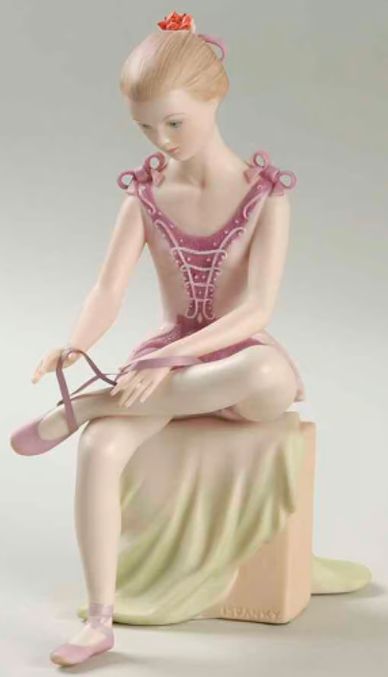
Below are numerous sculptures from the eras mentioned above that are a broad reflection of the more complex editions created by the "Living Master". Ispanky released well over 300 works in porcelain under his own name (in addition to the 100 or so created while with Cybis). While a separate website on Ispanky's porcelain work is planned for the future, the information below provides an overview of his unchallenged talent and multi-decade career in porcelain.















.