Smart Phone Users-Tap the 3 lines directly below for the navigation/site menu.
Looking to sell your Cybis? Smart Phone users expand the menu and go to Contact. Desktop/Tablet users go to Contact below in the navigation options.

Smart Phone Users-Tap the 3 lines directly below for the navigation/site menu.

The Cybis bird sculptures were some of the most spectacular creations ever offered in porcelain. Currently, the total number of birds created by the studio is unknown. The years between 1947 and 1958 were extremely prolific and a time from which few to no records survive. By the late 1950's the 300 series was designated for use in assigning design numbers exclusively for sculptures of birds. However, prior to this designation, dozens of bird sculptures had been released with design numbers starting with "9". The numbers were written on the bottom in pencil, as was the studio's common practice. These early pieces were made from fine china and had glazed surfaces. Each year sculptures are located that were not listed or shown in any of the studio's extant marketing material. Having not yet been cataloged to current online data bases, these discoveries are exciting for collectors and enrich the history of the Cybis studio now and for the future.

Released as an introduction celebrating the 200th anniversary of the U.S. Constitution the Golden Eagle was on open edition. The eagle was still available on the 1999 price list.
Issue / Completed Price
$895 (color) $1,195 on the 1999 price list
$550 (white) $895 on the 1999 price list

All eagles produced during the "Constitutional Celebration" were individually numbered. This likely meant orders received in 1987. Orders after the cut off were produced as open editions. It is not known how many were numbered.

The Dove was introduced as an open edition in 1987. It was still available on the 1999 price list and may have been sold through the 2000's on the studio's E-commerce web site. Marketing material promotes this small sculpture as a "gift" for any occasion. The nominal price (at the time) did make this dove a good option for gift giving but based on the lack of market saturation it does not appear it was much of a success.
Issue / Completed Price
$95 $125

At introduction this sculpture was part of the "Holiday Collection". That leads to speculation this may have been considered an ornament. While the brochure made no such mention, it gives the appearance it could be hung on a Christmas tree. The 1988 price list has the name as Holiday Dove in the "Wedding, Anniversary, Romance Gift Collection". In 1989 it was moved to the "Special Occasion Gifts" collection. After 1990 and before 1993 the confusion was cleared up as it was moved to the Birds section with the original name of "Dove".

No color or design variations are known to exist. Few were produced but it is periodically seen on the secondary market, unlike counterparts Baby Owl and Bunny Mr. Snowball.

This early 1950's set of two birds is the only example so far where both pieces in the set have the same design number. Sets were not common and were often listed as a "Pair" on price lists. The exact names are not known, but they've been referred to as Hungry and Grumpy.

These were likely sold as a set since both have the same design number 322. Once studio price lists or brochures from the early 1950's are located in which these birds are documented, more details may become available. A secondary market listing indicated their heights to be approximately 3" tall for Hungry and 2 1/4" tall for Grumpy.
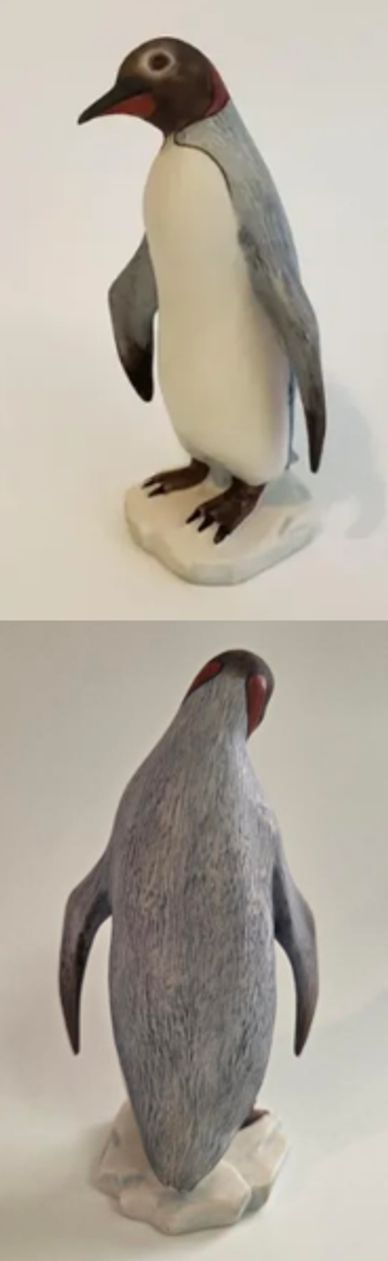
The 5 1/2" tall Penguin was introduced in 1966. It was produced for one year as an open edition. Assigned design number 365, it was closed in 1967. No design variations have been found, but decoration varies widely.
Issue / Completed Price
$35 / $35
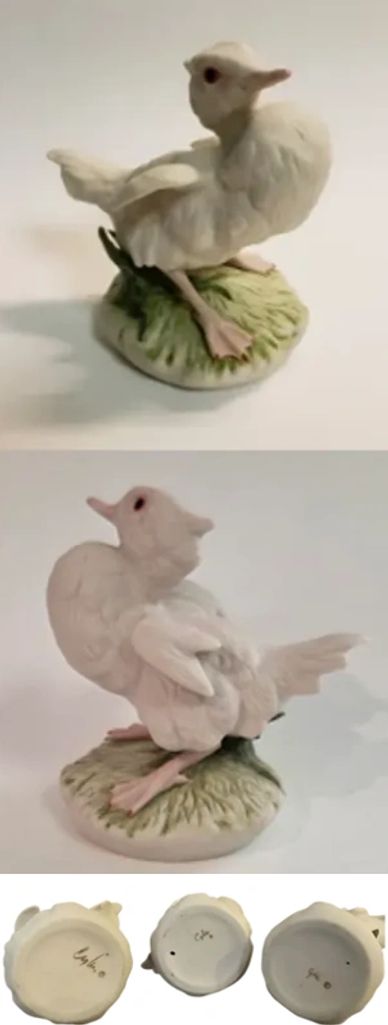
This open edition was released in 1962 and closed in 1979. Duckling Baby Brother was assigned design number 361. He measures 4 1/2" tall and has known design variations, specifically in the shape and size of the base. From examples seen on the secondary market three sizes were produced over the years. The differences are not easily detected until sculptures are compared side-by-side. The size becomes more apparent when compared from the bottom. No color variations have been found.
Issue / Completed Price
$35 / $95

Baby Duckling was introduced as an open edition as part of the 1989 50th Anniversary celebration. All sculptures produced in 1989 were marked with the gold 50th anniversary backstamp. The assigned design number is 6097. It measures 5 1/2" tall. There are no known design or color variations. Baby Duckling was still in production and listed on the 1999 price list.
Issue / Completed Price
$150 / $175 on the 1999 list

This open edition was released in 1962 and closed in 1965. The copy in this collection measures 3" tall by 4 1/4" long. No design variations are noted but minor color variations have been seen. These were likely due to individual artist's techniques.
Issue / Completed Price
$25 $25

This highly decorated quail has detailed painting on the bird's body with numerous plants and flowers around the base. This is a unique piece issued in the 900 series which was only used during the 1950's. The signature on this piece is from a stamp replicating the signature of Boleslaw Cybis. That indicates it was likely an item he originally decorated selecting the color and details. It is also marked #954 and "Cypia" designating the unique earthen tone finish. Production dates and pricing are unknown.

The Goose is another open edition with a design number in the 900 series. Also released in the 1950's, it measures 7" tall. Release and retirement dates, as well as pricing are unknown.

This open edition released in white and color was made between 1957 and 1962. It uses the same mold from the Holland Mold Co. to create the duck as seen in similar duck sculptures that follow.
Issue / Completed Price
$50 $50 white
$60 $60 color

This is another open edition released in the early 1950's. The mold used for this duck sculpture was the same mold used for the Duck Pair and Wild Duck #337. The actual design number, exact release date and pricing are not yet known. It was likely closed
prior to 1957 in preparation for design number 337. With the new design the old one was retired.
It measures 5 1/2" tall by 5" wide and has the hand signed Cybis signature incised on the bottom.
Issue / Completed Price
$-- $ Unknown


Released in 1983 as an open edition, Woody was retired in 1986. He measures 4 1/2" tall. There are no design or color variations.
Issue / Completed Price
$* $145

Introduced in 1952 as an open edition, the Bluebird was closed in 1962. It was available in both white and color. This piece is rarely seen and it's not known if there are any color or design variations. The measurements given are 6" tall. The example pictured above is 5" tall and not marked with a design number. It has the incised Cybis signature on the bottom. It is assumed to be #329 but well may not be. This will only be confirmed if another copy is found that is marked "329" or a catalog image is found.
Issue / Completed Price
$30 $30 white
$37.50 $37.50 color

This bird is yet to be identified. It was likely from the mid to late 1950's as it has no copyright symbol and is hand signed with the Cybis signature on the bottom. Known color variations exist. Design number and pricing details are unknown. It measures 6" tall to the top of the branch. The mold for this bird was recycled for the Palm Warbler, Brown Sparrow, Western Tanager and possibly others.

This small bird was produced in a variety colors in the Stained Glass finish. The two above are the same mold witht very minor differences noted in the hand formed leaves below each bird. It is not known what kind of bird each is supposed to represent. The darker bird has the 1950's Cybis stamped logo while the lighter version has the hand signed Cybis signature.

This bird is yet to be identified. It was issued in the late 1950's and had it's mold recycled for use in the Golden Crowned Kinglets pair. This piece measures 5 1/4" tall.

The brown bird shown here is another 1950's stained glass sculpture which is assumed to possibly be a Sparrow. No design number is found on the bottom so until marketing material surfaces or another copy with the design number written on the bottom we have no information on this piece. What can be known is that it was created from a Holland Mold Co. design. Both the bird and base it sits on were used in other designs released by the studio.

This majestic eagle was introduced in 1986 as a limited edition restricted to 300 copies. In 1988 an additional 30 copies were announced for distribution outside the continental U.S. Pricing was increased significantly and likely contributed to slowing sales. The American Bald Eagle was still available in 1999 and possibly into the early 2000's. It's doubtful all 330 copies were ever completed.
Issue / Completed Price
$2,900 $5,995 on the 1999 price list

By 1993 the studio announced an all white edition as design number 6161. What is not specified is if there were 330 to be available in white or if part of the original edition would simply now be available in white. The 1993 price list shows the white copy priced $1,000 below the color version at $3,975. As of 2026 there have been no recorded sales of the white version on the secondary market. If any were actually created and sold, none have been documented so far. One unusual copy in white was included in the studio's liquidation auctions. (Shown below)

Stated measurements given in marketing material list a height of 24". The eagle in this collection measures 23". Of the sculptures offered on the secondary market where listings noted an actual height, 23" tall has been the standard. That indicates the original measurements may have been taken from a prototype and production copies are all slightly smaller. It is 18" at its widest point. Standard display cabinets will not accommodate this sculpture. The wooden base (permanently attached) is 2" tall. While the exorbitant price was the primary factor contributing to slow sales the enormous size of this sculpture prevented some buyers from purchasing due to space constraints.

A badly damaged white copy was included in the studio's liquidation sale in 2019. It was not attached to a base and appears to have been glazed. This was not simply an unpainted copy as no part of the color version had glazed surfaces. This seems to indicate that prior to becoming damaged it may have been a white version for sale at the studio. If like the other items sold in the 2019 auctions, it had AP painted somewhere next to the Cybis signature.

No design variations have been found but color variations are noted. The eagle's feathers will range from reddish brown to golden brown. Of the five historical sales records on the secondary market available three have had damage. Two of those had chipped talons and the white copy shown previously has a feather broken off of one wing.

The brochure and catalog images never successfully captured this sculpture in a way that did it justice. It is hard to fully realize what a powerful sculpture this is until viewing it in person. Upon seeing an actual copy, the first impressions are spectacular. It was the last and final release the studio offered that lived up to the title of "museum piece".

The Kestrel was introduced as a limited edition restricted to 350 copies. By 1980 sales had slowed and the edition was reduced to 175. The edition was closed in 1982. No price increases were noted during its five year production.
Issue / Completed Price
$1,875 $1,875

No variations are noted between the image shown in the 1977 brochure or subsequent catalog photos and production models. The sculpture appears to have been introduced as designed with no modifications prior to release. Color variations are noted in the berries on various sculptures. It appears the artists did not maintain strict standards in painting the berries exactly like the proof. A red berry on one piece may be purple on the next. Earlier copies are preferable as they are better executed +with greater detail. Later editions appear sloppy with heavier use of the airbrush and little hand detail.

The measurements given in marketing material state 18" tall on the attached wooden base by 14" wide. Actual height is 17 1/4" tall.
The Gyrfalcon was released as a limited edition restricted to 25 copies in 1987. Even at the stunning price of $8,000 all 25 copies were ordered in record time. Had only 25 copies been produced as announced it is likely the edition would have been completed by 1988 or 1989. But that didn't happen.
Issue / Completed Price
$8,000 $12,975 on the 1999 price list

It is not known what explanation was offered by the studio, but the edition size was increased. It jumped from 25 to 110. On the 1988 price list, and all following lists through 1999, the Gyrfalcon was shown as an edition of 100 with 10 additional copies for distribution outside the continental U.S. The only honest explanation is, once it was realized this sculpture was a hit at this price, more had to be produced. Clearly this was another massive marketing blunder that was disingenuous, contrived and did not set well with merchants who often touted these larger museum pieces as worthy investments. An edition of 25 priced in this range for an impressive sculpture was realistic (at least to 25 customers) but once the edition shot to 110, those 25 customers vanished. The Gyrfalcon went from boom to bust. Few orders came in after the announced increase and it's probable many orders were canceled as the Gyrfalcon is seldom seen. It was never completed and remained available through 1999.

The Gyrfalcon was issued on an attached wooden base. The actual measurement is 23" tall without the base meaning it was 1 1/2" in height bringing the overall size to 24 1/2".
There have been no design or color variation noted so far.
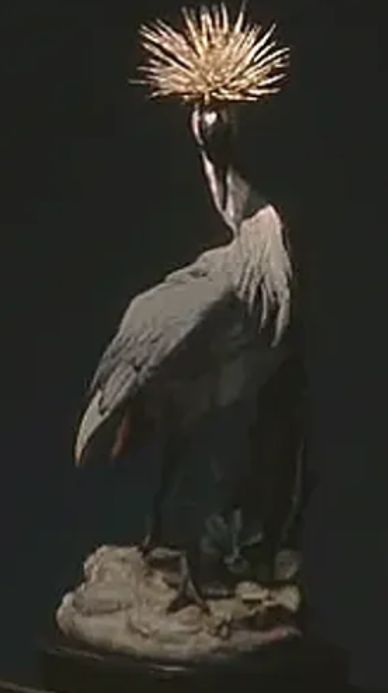
In 1963 Cybis began planning for an exhibit in the 1964 World's Fair to be held in New York City. The fair opened on April 22, 1964. The studio began work on perhaps one of the most intricate, fragile and highly detailed sculptures it would ever produce. The Crown Crested Crane may have been initially planned as a limited edition. However, it may be that production problems led to the decision to limit the crane to a "show piece" for the fair highlighting the studio's extraordinary artistic capabilities. It was never offered for sale. Details on the crane are limited. It is listed in the 1971 book Cybis in Retrospect as produced in 1964. It's listed in the Alphabetical Guide to Sculptures in the back of the 1978 and 1979 catalogs where it is noted as a limited edition restricted to 1. Cybis in Retrospect also states the crane was still owned by (or in the collection of) the Cybis studio in Trenton in 1971.
Issue / Completed Price
Never declared
During the early 1960's the studio's master sculptor and chief designer, Laszlo Ispanky, created some of the most iconic sculptures that defined the Cybis studio's future and identity. Ispanky created the crane in an artful mastery of balance and style. This stunning sculpture, while impressive and eye catching, was far to complex for regular production. Standing on its two legs, the bulk of the crane's weight is supported by three sword-like stems similar to the mother-in-law's tongue plant. This structure alone presented significant production challenges. Once the molded pieces were assembled, there was no guarantee the sculpture would emerge from the kiln in the position desired, or even in one piece. This brings to light the fact the studio never produced ONLY one of anything. There was always a "spare." Production issues aside, the crane had to be transported and the risk of damage or total loss was a very real possibility. There was always a second (or third) copy for a back-up in the event it was needed. The sculpture shown here, was purchased for this collection at auction in 2026. It is marked AP and may or may not be the piece that was on display at the 1964 World's Fair in New York.
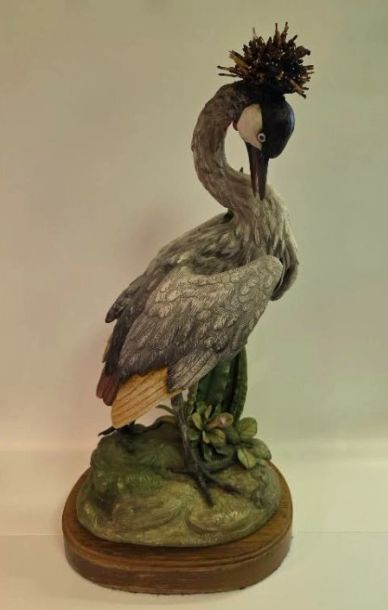
The measurements given in official publications are consistently stated as 16 1/2" tall. Attached bases were included when measuring height. The piece shown here currently measures 19" tall. As shown in the pictures, most of the plumed feathers on the crane's head have been broken off. The extent of the damage reinforces the fact this crane is extremely fragile. The plumes are thinner than angel hair pasta. The crane would have been a packing and shipping nightmare had it been produced. Knowing this piece is damaged, and many of the missing pieces were at least one inch long, the original height could have been in excess of 20"tall. Without the base, this piece would still measure 18 1/2" tall prior to any damage. That is 2" taller than the stated height. Either a mistake was made in the recorded measurement or this piece may have been a spare that was slightly larger than the copy on display at the World's Fair. If so, the copy on display may have been numbered as "#1". That would explain why this copy is marked "AP".
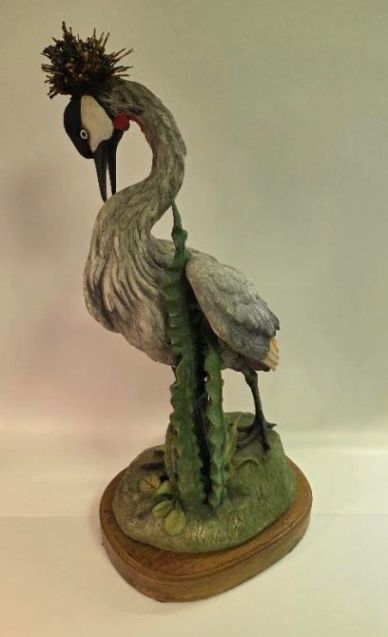
The three succulent type sword shaped green stems provide the primary source of support for the crane's weight. The two legs provided some stability but positioning indicates they carry little weight.
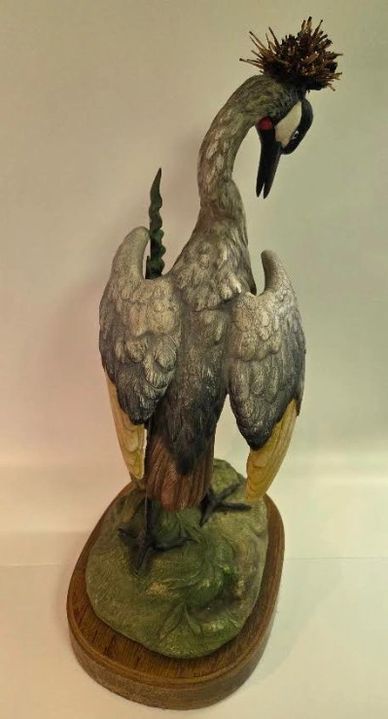
The golden wing tips and brown tail feathers are visible from behind.
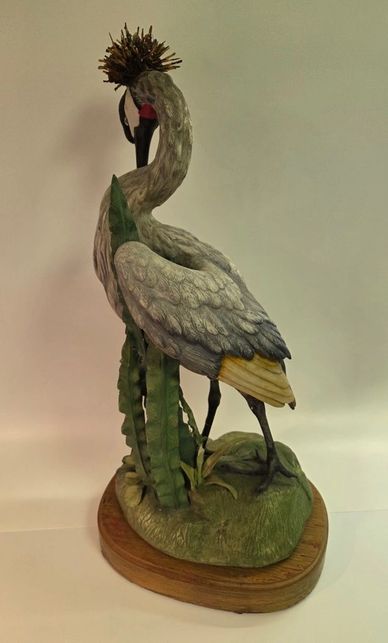
Weighing in at 6.6 pounds, this is an extremely heavy sculpture. The wooden base accounts for approximately 1/3 of that weight as a similarly sized wooden base from a House of Gold Madonna weighs 2.2 pounds.
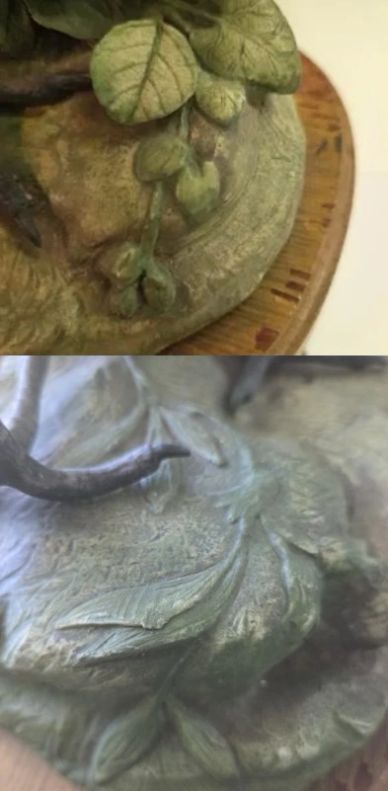
The crane stands on a porcelain base designed with molded elements to provide additional interest. Considering the studio was potentially working on a tight deadline to have this sculpture ready for the fair, this may have been done to stay on schedule. Such a decision would have avoided the additional hand crafted flora that was time consuming and presented additional kiln risks. It's possible by the time the base was designed, earlier tests may have proven problematic enough that the piece had been cancelled as a production item. If so, why go to the extra trouble? Later wildlife sculptures used standard themes of ledge rock, limbs or branches for bases and support, avoiding flora altogether. This adaptation to production proved easier, faster and certainly more cost effective.
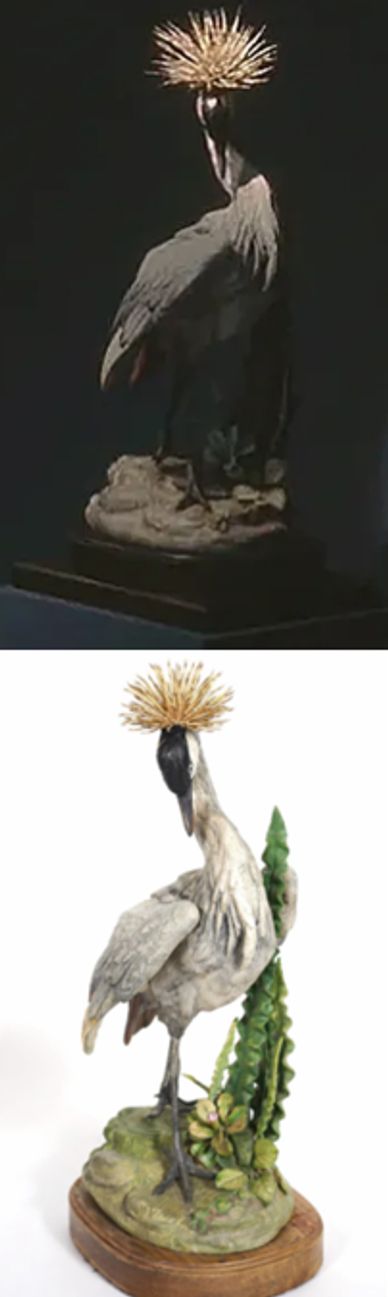
Here the crane has a full plume restoration with the help of A-I (artificial intelligence).
The one bloom on the plant has a very slight tinge of pink color. The focal point was on the bird's "crown". Understandably, color was avoided on the base.
The crane was not the only limited edition sculpture restricted to one. Both St. Peter and the Floral Bouquet of the United States were editions also restricted to "1'". It is known that both of these had at least one spare. An unfinished copy of St. Peter (in Cypia tones) was sold at auction in 2019 as part of the studio's liquidation sale. Pictures of the Floral Bouquet show it on different stands and with components such as butterflies and flowers on one piece that are missing on the other. The bouquet is now in the Smithsonian. Measurements stated by the museum are smaller than those stated in the studio's publications. Two other editions restricted to "1" were the Presidential Chess Set and American Buffaloes. Both were later modified and released as limited editions. The chess set was limited to 10 and the buffaloes to 25. One other limited edition restricted to one is Tribute to President John F. Kennedy, but it is not known if it was ever publicly exhibited.
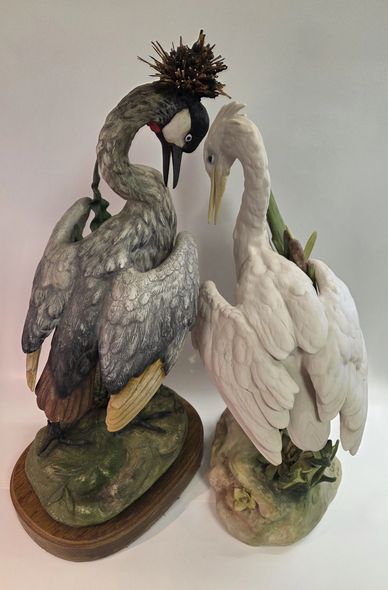
The studio started recycling molds for use in creating new sculptures beginning in the 1950's. Looking at the backs of these two birds positioned side-by-side, it's obvious no common molds were shared to create either sculpture. Only a master sculptor could design and create two outstanding sculptures to be so alike while obviously so different. Unlike other inhouse artists who created new designs for the studio recycling molds and using parts and pieces from previous sculptures, Ispanky drew exclusively on his unmatched talent and unique gifts to create individual sculptures.
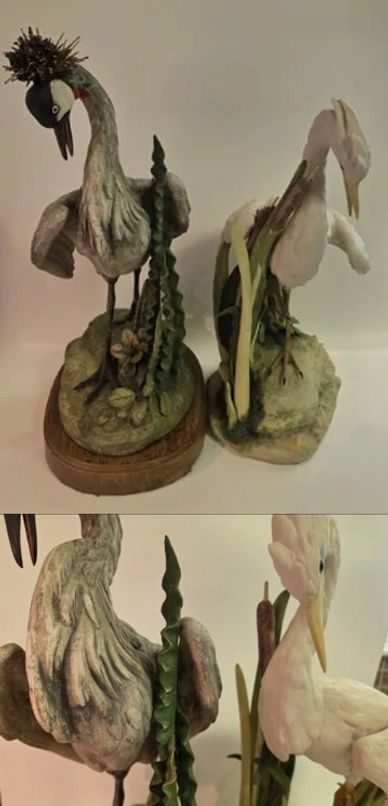
Here the comparison between the two clearly shows each sculpture was created as an original design. The shape of each bird's head, the layering of the feathers, the thickness of the bodies and the design of the wings is unique on each bird. Neither bird was made from the other's mold.
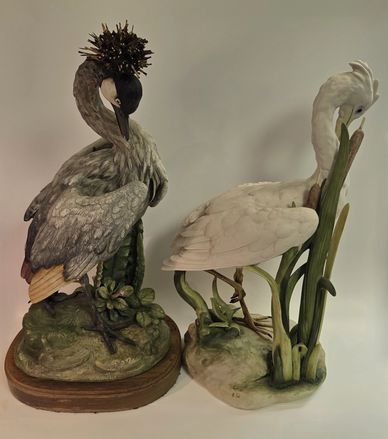
While the Great White Heron was sold with a wooden base, it was not permanently attached as was the case with the crane. This may be one of the issues that surfaced when producing the crane. The extra weight attached to the base could create stress during shipping that would result in damage. The plumed crown was already a massive concern and the base didn't need to add to worries! It would seem the lesson was learned with the crane and the studio opted to cover the bottom of the heron with felt so it could safely rest on the accompanying base without scratching it.

The Great White Heron was introduced as a limited, numbered edition restricted to 350 copies. Cybis in Retrospect states the release date was 1965. Later studio publications show a release date of 1964. The picture appearing in the 1965 catalog (possibly the prototype) shows the first design that would be the Great White Heron. Note the additional reeds at the front of the sculpture and on the other side for addition support. These were redesigned and thinned out in the production version. Other minor variations are evident. The heron was completed and closed in 1973.
Issue / Completed Price
$850 $1,350
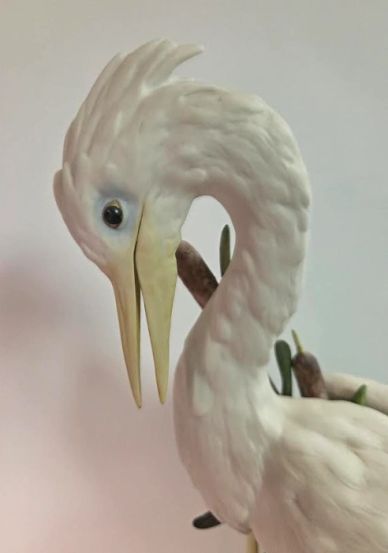
The lifelike design is so realistic it's possible to imagine this heron thrusting its beak downward to catch a fish at any moment.
The Heron, design number 359 was released a year after the Crane, number 360, debuted at the New York World's Fair. It's likely the studio's master sculptor and chief designer, Laszlo Ispanky designed both at the same time but priority was given to the Crane in order to have it finished and "show ready" by April 1964. Because of the similarities between the two, the heron's structural design was improved to offer greater support as mentioned earlier.

The Great White Heron was shipped with a wooden base. The measurements given in marketing material include the base for a whopping 19 1/2" tall. With no base (pictured above) the piece, measured in this collection, is 17" tall. As stated numerous times across this site, it is always preferable to have the original base if it is still with the sculpture. Most have been separated over the years and lost. As long as a piece is in mint condition with no damage or restoration of any type, a missing base should not affect value. However, an original base still with a mint condition sculpture commands a premium.

From the back side, the support provided by the reeds and cattails becomes obvious. The final version with the redesigned and reduced support creates a less cluttered and more aesthetic presentation.
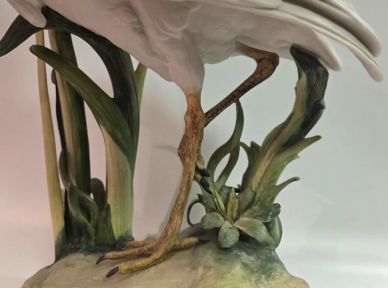
Similar to the Crown Crested Crane the Great White Heron has supporting plant life that brings balance and stability to the sculpture. Additionally, the heron is only standing on one leg while the crane is standing on two.

Beyond the variations noted with the prototype only variations with the plants on the base have been seen.

Introduced in 1960 as a limited numbered edition of 500 the Little Blue Heron was completed in 1971. The edition was completed and all 500 copies were made.
Issue / Completed Price
$425 $500

Like the Great white Heron, the Little Blue Heron also relied on reeds next to it for support. As structural elements these added aesthetic appeal to the sculpture providing greater interest. There were no significant design or color variations beyond the expected differences that resulted from the firing process.
The sculpture was sold with an accompanying wooden base. It was not attached to it. Unfortunately, most sold on the secondary market are missing the base. This is a shame as it is a very handsome piece when on the base.

As a fairly sturdy piece the heron is not difficult to handle, but like most porcelains it should be handled from the bottom without lifting it by the reeds or the bird.
Bird's eye view (pun intended) gives another perspective on the sculpture's width. This is a factor that must be taken into consideration for every item displayed in cabinets, particularly narrow or side-loading models.
The smaller moss-type decoration around the reeds on the base will often be chipped or damaged due to mishandling.

This sculpture was released in 1972 as a limited edition restricted to 500 copies. In 1978 the edition was reduced to 400. The edition was closed in late 1979 and not listed on the 1980 Spring price list.
Issue / Completed Price
$975 $1,000
The Bob White Chick peers out from under the leafy green blades of the iris almost unnoticed.

This small sculpture is complex. The complication of the assembled components makes it easy to overlook this piece when among other sculptures. It's easy to miss the simple beauty because it feels busy.

The angled design of the attached wooden base adds character to this sculpture.
The name of this sculpture , American Crested Iris with Bob White Chick obviously gives top billing to the floral theme. The Bob White chick brings additional interest to what may otherwise appear as just a big clump of flowers. If there was no chick this piece would be in the Porcelain Gardens section.

The American Crested Iris was the second release of an Iris by the studio. The first was in 1963.

The additional foliage behind the chick helps visually anchor him to the base. Without it, he would be more at risk of looking out of place.

From a "bird's eye view" the overall width of this sculpture is evident. it is far wider that it appears from a frontal view.

The Blue Headed Vireo was introduced as an open edition. Likely in development in the late 1950's it was released in 1960 in both white and color. It was closed in 1965.
Issue / Completed Price
$75 $75 (color)
$60 $60 (white)
The black and white photo found in published marketing material (previous image) shows the Vireo on a wooden base. Early copies were attached to the wooden base as shown above. The sculpture was positioned so the Vireo is centered.

The position of the leaves will determine the actual height of the sculpture as some were positioned and fired in a more upright stance. Stated measurements included the base coming in at 8 1/2" tall. The Vireo on the base in this collection measures 7 1/2" tall. Again, this is due to the way the leaves were attached to the branch during the mounting process and accounts for shrinkage during firing.

The first copies had the supporting structure designed as a branch with openings on both sides. When positioned at a certain angle, it is possible to see through the branch (directly below the Vireo). That hole was later closed on the back side. This supporting "branch" structure was also recycled for use again in 1963 as the supporting structure for the Windflower. It was no longer brown, but rather white, taking on more of a windswept clay structure. Of the dozen documented sales on the secondary market for the Vireo, only three were on the wooden base. Two listings were for the first version and one was the second version (shown next). With the second version having the hole closed and the Windflower not having a hole it could be assumed the second version was released well before 1963. The redesign could have been as early as 1961 since not many of the first version sculptures are found.

The first redesign (second version) was short-lived as it is rare and seldom seen. This copy demonstrates clearly the transitional process as the first version was modified. Here several variations are noted as the flower was added at the top. Note it is in yellow and brown tones. The leaves show minor serrating on the edges. The hole in the back of the branch has been closed.

Several of the early 1960's birds were redesigned without wooden bases. This was simply part of the studio's evolving business model to streamline production and reduce expenses. Ultimately, it created exciting options for serious collectors. With the Vireo, the third version was released with no base. This had a benefit for a small sculpture of this size. As buyers became collectors they often bought lighted display cases for their homes. When placing smaller items on the top shelves, light was blocked by the wooden bases making lower shelves dark and other pieces harder to view. Ultimately, redesigning sculptures without a base or for some, not attached to a base, meant the issue was resolved. Sadly, the issue of sculptures not being attached to their base means the base often got separated and eventually lost.
The third version is most commonly found. The base was removed which makes the piece 3/4" shorter. The sculpture without the base in this collection measures 6 3/4" tall. It should be noted that catalogs and other published material continued to use the originally stated measurements when sculptures were redesigned and bases were discontinued. In the Vireo's case the removal of the base coupled with repositioning the leaves and shrinkage during firing, there is a 1 3/4" difference between the stated height and version three.

The third version has leaves with heavy serration and the color of the flower was changed to pink. The Vireo also has far more blue on his back than the previous two versions.

Color variations abound on the Vireo. This is uncommon for a sculpture produced for only half a decade.

Introduced in 1961 as an open edition, the Goldfinch was available for four years. It was closed in 1965. It was available in both color and white.
Issue / Completed Price
$60 $60 (white)
$75 $75 (color)

The black and white marketing photo (previous image) may have been a prototype that was never produced. It has clusters of berries or flower buds. So far no copy like that has been documented. It is probable the production model was changed to the small purple flowers as shown above prior to introduction. All early sculptures found are mounted on the wooden base, have larger leaves and the extend branch arching over the top of the sculpture. If the design with berry clusters were found the purple flower design would be the second version.

The measurements stated in marketing material traditionally were a reference to height unless both height and length were stated. If so, then the first number always referred to height and the second number referred to length. Understanding that, it is obvious the 6" measurement for the Goldfinch was an error. On the base, the copy in this collection is 4 3/4" tall. The base is 7" long. While unlikely, the prototype may have been 6" tall on the base. If so, it was downsized significantly and the new height was never recorded.

The final redesign was probably by 1963 with the release of the Magnolia. The branch structure was recycled and used on the Magnolia. With the Goldfinch revision, the arching branch structure was eliminated so it looked less like the new Magnolia. The base was discontinued, the flowers were changed to large open blossoms in full bloom and the leaves were made smaller. The Goldfinch also got new color scheme changing the color of his wings.
While the base was "stretched" to enlarge it for the Magnolia it does not escape recognition. It is particularly obvious when viewed from behind.

The revised goldfinch looks lighter, refreshed and was probably thought to look more modern by 1960's standards. The smaller leaves also had a trailing thorny stem that hinted at the new Rose which was released in 1964 using the same base structure (shown below).

With the discontinuance of the wooden base the Goldfinch's height shrank to exactly 4" tall.

Comparison of the flowers on the two version is shown above. Also note the color of the birds wings.

Here the Rose, introduced in 1964, is shown along side the Goldfinch. When shown together it is easy to see the structural base is the same mold. It was flipped upside down and rotated 90°. But this is not the last time this branch would be utilized. The same structure would reappear in 1977 as the base for the Clematis!

The Goldfinch with Violets was introduced in 1988 as the second Goldfinch the studio produced. It was an open edition and was still available on the 1999 price list.
Issue / Completed Price
$425 $795 on the 1999 price list
The production sculpture appears to be the same as the copy shown in the 1988 black and white Spring brochure. The 1988 brochure was the first publication the studio released in black and white in more than 15 years. This subtle change was, for many, evidence of the studio's mounting financial difficulties and the beginning of its ultimate demise.
Baby Owl was one of the first sculptures released in porcelain. He was issued in 1957 as an open edition. He was redesigned in the early 1960's with a smaller group of leaves next to the stump. He was still in production in 1999.
Issue / Completed Price
$18 $195 on the 1999 price list

The earliest versions have a larger group of leaves sprouting next to the owl's raised foot. The color scheme was in earth tones with shading around the owl's face. The new version had fewer leaves next to the stump and two additional leaves on the other side. The studio later released a Christmas version with holly leaves and berries.
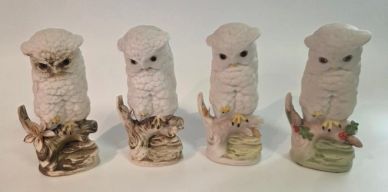
Above, four versions are shown. The first release was in Cypia tones with one large clump of leaves. The next version reduced the leaves on the left and added a sprout on the right. The third version saw a color change with a fourth edition being the Christmas version. The sweet disposition and small size of the Baby Owl made him appealing to nearly every collector. This sculpture was, and still is, found in most every Cybis fan's collection. It was also often selected by Cybis collectors for gift giving. Due to it's appeal and affordability, the studio certainly produced several thousand copies of the Baby Owl.

The Great Horned Owl was one of the earliest porcelain sculptures released in 1956. It was available in color and Parian white. Both the color and white versions were closed in 1968.
Issue / Completed Price
$100 white $150
$150 color $200

The owl was produced using a mold purchased from the Holland Mold Co. It was one of the earliest porcelain sculptures (all others had been previously produced in fine china) released in the mid 1950's. It is possible it was the first issued in the 300 series (the 300's were used for birds). Unless a design number 300 surfaces in the future, it may be this owl is the first one.

Catalogs indicate the owl was 19" tall. The owl in this collection and others listed in historical sales site measurements of 17 1/2". This would seem to indicate the first copies were sold with a base, but marketing materials do not show pictures where a base was included and no mention is made of the owl coming with or on a base.

Introduced in 1975 the Great Horned Owl KooKoosKoos was a limited edition restricted to 200 copies with 50 in color and 150 in white. The white version was completed in 1978 while the color version was completed in 1979. All 200 copies were produced.
Issue / Completed Price
$1,950 white $2,250
$3,250 color $3,250

Unlike other white editions, in the case of KooKoosKoos, white referred to the color of the owl only as the rest of the sculpture was decorated with color. Other white editions were solid white with no color at all, these are referred to as Parian white. This piece has broad appeal, particularly to men. It is not commonly found on the secondary market and has held it value considerably better than many other of the larger sculptures.

Attached to the wooden base KooKoosKoos measures 19 1/2" tall. It seems the original measurements may have been taken from a prototype and production items are a bit shorter. Due to the overall size, 20" by 14" by 11" this sculpture does not fit inside most display cabinets and must be displayed in the open. While it still has fragile parts, the overall construction is sturdy making it easier to handle.

Introduced in 1969 as the American Screech Owl with Virginia Creeper, this limited edition was restricted to 500 copies. Featured in the 1970 catalog, its name was shown simply as American Screech Owl. The 1970, 1971, 1972 and 1973 price lists show it as Fully Subscribed with the declared limit of 500 unchanged. After 1973, the owl was never mentioned again in any of the studio's marketing material. It was not listed on the 1974 price list which includes a detailed listing of both current sculptures and completed items. There were no prices given between the 1969 and 1972 price lists. The 1973 list states $1,500. There were no price increases for the Screech Owl while available.
Issue / Completed Price
$1,500 $1,500 on the 1973 price list

Few sculptures produced by the studio are wrapped in as much mystery as this one. It is never seen. It's understood this piece had extensive production problems which were coupled with excessive shipping damage meaning only a few survived. Even though the owl was FULLY SUBSCRIBED in 1970 with merchants having placed orders for all 500 declared copies, it is probable fewer than 10 owls actually were received in tact by merchants and sold. With the exorbitant loss rate, the studio closed the edition and canceled the remaining unfilled orders. One long term dealer who owned a gallery in Atlantic City for many years (and still deals in Cybis on the secondary market) stated this piece had only been available one time in the gallery. When it sold, it was hand delivered. None have been seen since.

The Screech Owl is smaller than expected. After seeing the 1956 Great Horned Owl and the Great Horned Owl KooKoosKoos it is natural to expect this sculpture to be bigger than it is. At 13" it is a full 7" shorter than KooKoosKoos. This specific sculpture measures 13 1/4" tall. It was located in Dallas, Texas in 2025 and acquired for this collection after the owner sent a message using the contact form on this site. It is #6. It was originally owned by an executive of the Zale Corporation (Zales jewelry store). Zale sold Cybis for many years through Corrigan's in Texas and Bailey Banks and Biddle in the northeast. It had been boxed and stored in a closet along with several other rare Cybis items for over 40 years.
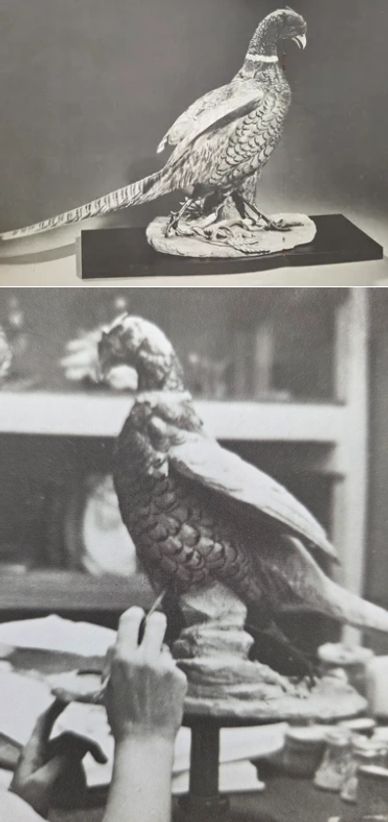
The Pheasant was introduced as a limited edition restricted to 150 copies. Due to the intricate hand painted details on the pheasant's feathers production was slow. The last piece was not completed until 1976. All 150 copies were produced with the price more than tripling in 16 years.
Issue / Completed Price
$750 $2,500

The production model was redesigned with one large branch attached to the pheasant to provide stability. This change was made after the initial marketing photo was taken (top image of previous black and white photos). An additional catalog image showing the pheasant being painted reveals the back side. It clearly shows support was provided by a rock structure. Such thick bulky components often proved problematic during production and may be why the design was changed to the branch. Larger solid parts often trapped air bubbles in the slip as the liquid porcelain was poured into the mold. When heated in the kiln the "trapped" bubbles would often explode causing a "kiln wreck" destroying everything. Once an issue was identified, the design was modified to prevent such issues.
This image was likely taken while the pheasant was in the later stages of design development. Of the historical sales on the secondary market, sculptures numbered as low as #6, all have the supporting branch. None have been found with the design shown in the black and white catalog image.
Catalog entries state the measurements to be 16" in height by 22" long. All pieces were sold with an accompanying wooden base, as shown above. The base is the full length of the sculpture. The actual measurements of the pheasant above is 15 3/4" tall on the base. The sculpture's length is 20 1/2" while the base is 22" long. Speculation that this sculpture was created using a mold purchased from the Holland Mold Company in Trenton is unfounded. While Holland Mold did produce a walking pheasant in a similar stance, it was smaller and had far less detail. One need only compare the exceptional detail of the Cybis pheasant to the minimal design of the Holland piece to see the two are not the same. The pheasant's large size, meticulous attention to detail and release in the fall of 1960 indicate it was likely one of the first sculptures created by Laszlo Ispanky after joining the studio. When acquiring this sculpture, a serious collector should seek a lower number produced at the beginning of the production run. Later copies were not as well executed and the painting of the back often appears less detailed and sloppy. The sculpture in this collection is #62.

No design variations have been noted among production models. Only minimal color variations are noted. The earliest copies have the best attention to detail while later copies should generally be avoided.

Painting by various artists resulted in some color variation but those were due to artist's style and not intentional.

The Hummingbird was introduced as an open edition in 1959. It was available in color and white. Cybis in Retrospect states it was closed in 1962. Later publications stated the Hummingbird was closed in 1963.
Issue / Completed Price
$95 $95 (color)
$75 $75 (white)

The Hummingbird is truly a rarely seen piece. There has only been one documented sale on the secondary market in the last 25 years. That item was purchased for this collection and is the sculpture shown here. So far no marketing material has been found which contains an image of the hummingbird. Therefore it's not known if design or color variations exist.

The actual measurements are 8 3/4" tall by 7 1/4" long. This would indicate a strong possibility of an accompanying base or that early pieces were attached to a base. The Hummingbird in this collection did not have a base and doesn't appear to have previously been attached to one.

Worth noting are the heavily serrated edges on the leaves of this sculpture. Many of the items released during this period have leaves with the detailed workmanship shown in this piece. Due to the extra time it took to produce these leaves, this process was discontinued during the early 1960's. With each leaf being hand formed it was too labor intensive impacting production time and the studio's profit margin. Older items with this level of detail are highly preferred over the redesigned items with molded leaves.

Until marketing material is located containing an image of the Hummingbird, there is no way to know how the studio intended for this piece to rest. With measurements stated as 9 1/2" tall, it's probable it' i meant to stand upright as displayed in the previous pictures. However, examining the underside of the sculpture, it's clear the base was designed to "lay flat" as shown in the image above. Stability is not compromised in either position, so ultimately it's up to the owner. Since the studio did recycle the structural elements used for branches and other supporting components, it won't be a surprise if another bird or flower is identified using the branch seen here.

The studio did not identify the flower this hummingbird is visiting. It's possible it was meant to be a Rose of Sharon.

The first Warbler the studio released was the Palm Warbler in 1957. This open edition was available for five years in color only. The Palm Warbler was closed in 1962.
Issue / Completed Price
$75 $75

This sculpture is only found listed in the 1978 and 1979 catalogs. It has a design number that appears significantly out of sequence for the dates of production recorded. An explanation could be there was a redesign and a new design number issued while maintaining the original released date in the studio's records.

The mold for this bird was used in the production of at least four sculptures. While each one is painted differently, the same round little body is easily recognized from one piece to the next. The Western Tanagers, Sparrow and a yet to be identified blue bird all share the same "bird-body" component.

This sculpture was introduced as an open edition in 1960. Available in both color and white it closed in 1963 according to Cybis in Retrospect and 1965 in later publications.
Issue / Completed Price
$90 $90 (color)
$70 $70 (white)

The details on this piece are extraordinary for the sculpture's size. It is typical of the high quality crafting done during the earlier years of the studio. All parts were hand made and assembled. This was a time consuming, labor intensive process that was retired in favor of molded parts to expedite production.

While the Cerulean Warbler isn't rare, it's not commonly seen. Of the items found in secondary market sales, only one copy was noted as not having a wooden base. The Warbler was attached to the base using a commercial grade adhesive/bonding agent. It is possible for sculptures attached this way to separate over time. Until other copies are seen, it's not clear if there may have been a redesign which removed the base. Several bird sculptures were updated in the first half of the 1960's where bases were discontinued, making this is a possibility. If this sculpture looks even a little familiar, it's likely because the branch structure was borrowed from the Maryland Yellow Throat. It was turned around backwards and had the Warbler and Azaleas added to create the new sculpture.

The Golden Winged Warbler with Andromeda was introduced in 1974 as a limited edition restricted to 200. The edition was completed and closed in 1979.
Issue / Completed Price
$1,075 $1,150
First planned as a much larger sculpture with two Golden Winged Warblers the studio scaled back the original design and used only the surviving bird as shown. The Andromeda had been made of individually hand formed flowers that were highly detailed. Those were modified into molded units for quicker production.
No design variations have been found but some minor color variations are noted. These are likely due to individual artist's style and technique.

Introduced as an open edition in 1958, the Maryland Yellow Throat was produced in white and color for three years. It was retired and completed in 1961. Later publications state 1963.
Issue / Completed Price
$85 $85 (color)
$65 $65 (white)
The Yellow Throat was attached to a wooden base.

The branch he sits on was shared with the Cerulean Warbler. It was rotated 180° to accommodate the Warbler when developed for its 1960 release. A companion piece was not created for the Yellow Throat. The flower on the sculpture was not identified in the title of the piece, as was the case with other releases. It does however appear to be a commonly used design often seen on other sculptures.

In spite of a five year production, this sculpture is never seen. The detail in the sculpture in this collection is a fine example of the outstanding work the studio produced in the late 1950's.

None of the extant catalogs contain an image for the Yellow Throat making it impossible to determine if the production model varied from the picture used in marketing material. It is possible a brochure was released with an image, but none have been found from this period. As a rare piece, it's not known if there were any color or design variations. To date, only one copy is recorded in secondary market sales and it was obtained for this collection.
If a redesign took place, it may have included the discontinuance of the wooden base.
The Wood Wren with Dogwood was introduced in 1963 as an open edition sculpture which included an accompanying wooden base. Available in Parian white and color when released, the white version was discontinued the following year in 1964. To date no Parian white copy of the original version has been offered on the secondary market (since the year 2000). Literally hundreds of color copies have sold so it is likely few white sculptures were ordered by merchants (if any), thus the quick closure of the white version. The color version remained in production through 1981 and remained on price lists in a "Retired" status through 1982.
Issue / Completed Price
$55 $55 (white)
$70 $395 (color)

The sculpture pictured in early marketing material, including the 1964 Commemorative copy of the World's Fair edition, shows a dogwood branch with handcrafted flowers and leaves. It is shown in the previous black and white picture. Each blossom was assembled from four petals and the leaves were detailed with serrated edges. This may have been a prototype that was never produced as all copies found have the blossom made from a single mold and leaves with less detail. The original release had only three flowers. This first version (shown above) had leaves which were not serrated and clustered stamen which appear more tubular.
Measurements were consecutively stated, beginning in 1963 and year over year thereafter, as 5 1/2" tall. The three flower version measures only 4 3/4" tall with the accompanying base. It's not clear why the measurement was given as 5 1/2" as the bases were approximately 3/4" tall. The sculpture measures 4" tall. Once redesigned, the four flower version measured 5 3/4" tall standing alone and 6 1/2" tall with the accompanying base. Some size variation will be due to unexpected kiln shrinkage but not usually up to an entire inch on a small piece.

Minor design variations are noted among items from the original release. The leaves became less detailed and the stamen were again changed. They were redesigned into a cluster of nubby pieces as opposed to the singular mold of the tubular cluster.

At some point in the mid 1960's the Wood Wren with Dogwood was redesigned making the branch structure taller and wider while adding a fourth flower. Also the birds color was changed removing the yellow. The new design would remain available with the wooden base through August of 1975.

The redesigned version remained unchanged through the rest of production which ended in 1981. Several color variations exist in the shading of the flower tips, color of the stamen and the leaves.
There are minimal differences in the way the wren's feathers are painted but these are due to individual artist's technique and style.

The Clematis with House Wren was introduced as a limited edition restricted to 500 copies. That number was reduced to 400 by 1975 as orders had slowed. The 1975 price list also records the price increased to $1,350. The decision to reduce again came late in 1974 as the Spring 1977 price list shows the edition was complete and had been closed with a final edition of 350.
Issue / Completed Price
$1,300 $1,350

This sculpture was extremely complex for its size of 12" in height. It was the second piece the studio created with a wren. The first wren created was the Wood Wren with Dogwood shown previously. Like the Dogwood, the Clematis is the focal point in this sculpture. As small birds, it appears the wrens were secondary subject matter rather than the primary focus.

The tender vines and trailing stems add to the interest of this sculpture as well as its intricacy. The detail of the flowers on this piece were the last to receive this level of workmanship as the studio continued to migrate toward solid molded pieces that allowed for faster production. Not until the Cybis Courtyard Collection was released would there be any flower created with as much detail as is found on this sculpture.

The House Wren bares a greater likeness to the actual bird compared to the Wood Wren.
A delight from every angle, the wren looks like it is ready to take flight at any moment.

Details shown here of the top. This is an area often noted with damage.
The clematis flower was created by laying one molded four petal top piece on top of another. Then the stamen and pistols were attached.

This part of the sculpture can easily be damaged due to mishandling. The stamen is often seen missing and pistols are broken. These sections should be examined under bright light as the colors used make them difficult to see.

In 1977 the Clematis was introduced. As with many of the studio's sculptures it was born from recycled parts. In this case, the flowers and an opening bud were "borrowed" from the earlier design and attached the same structural base used for the Magnolia, Rose and Goldfinch.

The top flower, made from a separate mold, is slightly smaller than the other two. This area is often damaged with petals either broken off or the flower missing entirely.

This piece has several areas on the back and side where spiraling "vines" shoot off the main stems. These spirals make handling this piece very difficult and are areas where damage is commonly found. These should be noted and observed prior to handling. If purchasing this sculpture check each vine to verify a part was not snapped off and is now missing. Sloppy repair jobs are also often noted among these areas.
There is only ONE way to safely handle this sculpture. Firmly grip it at the bottom where there are no fragile components. Lift it and immediately place your other hand under the base. This will prevent touching any fragile parts that will certainly break under pressure from a misplaced finger or thumb.

The Wood Duck was released as a limited edition restricted to 500 copies in 1968. It was completed in 1972 with all 500 copies produced. No price increases were made during the four years of production.
Issue / Completed Price
$325 $325

No design or color variations have been noted.

Detail of duck's back showing intricate colors.

While the majority of copies sold on the secondary market have had bases like the one shown in this collection, copies have been seen with rectangular bases.


