Smart Phone Users-Tap the 3 lines directly below for the navigation/site menu.
Looking to sell your Cybis? Smart Phone users expand the menu and go to Contact. Desktop/Tablet users go to Contact below in the navigation options.

Smart Phone Users-Tap the 3 lines directly below for the navigation/site menu.





The full name for this open edition, released in 1978, is Nestling Bluebirds on Cockspur. Issued as design number 386, the bluebirds were retired in the fall of 1979. They measure 4" tall and there are no known design or color variations. These birds are frequently seen with damage when offered on the secondary market.
Issue / Completed Price
$235 - $245

Released in 1977 as an open edition the Ducklings were assigned design number 383. Measuring 5" tall and 6 1/2" wide, the ducklings have no known design or color variations. For no apparent reason the name was changed on the Spring 1980 pricelist to "Baby Ducklings Buttercup and Daffodil". The Ducklings were retired in 1981.
Issue / Completed Price
$165 - $295

Another introduction of baby birds, The Baby Chicks were also an open edition released in 1979 as design number 387. The Baby Chicks measure 4" tall. Retired in the fall of 1981 the chicks have no identified color or design variations.
Issue / Completed Price
$215 - $275

.

.

.



This pair was initially released as a numbered edition restricted to 500 but was later reduced to 275 pair. The edition was listed as closed in 1975.
Issue / Completed Price
$1,200 $2,100

While the standard issue had white lilacs these sculptures were also released in a pink variation.

.

.

.

Introduced in 1957 as a numbered, limited edition restricted to 500 copies, the Turtle Doves, "Doves of Peace" closed in 1970 with all 500 copies produced.
Issue / Completed Price
$350 $350
This is one of the most iconic sculptures ever produced in porcelain on several counts. It made history and set the world standard as the first ever limited numbered edition of a porcelain sculpture. The Cybis studio was the first porcelain manufacturer of fine art to declare a set number of copies created for collectors. This was the match that ignited the firestorm in the collectibles market that persisted through the 1990's.

The Turtle Doves were selected as the official gift of state presented by President Jimmy Carter to Leonid Brezhnev of the Soviet Union in 1979. The copy presented to Brezhnev had a gold plaque attached to the front commemorating the meeting in Vienna.
Marylin Kozuch-Chorlton was the owner of the Cybis studio during the pinnacle of its production from 1958 to 1977. Marylin and an assistant, designed and created the Turtle Doves which were released in 1957. She not only owned the studio that released the first numbered limited edition porcelain sculpture, she captured the title of first female artist to create a highly sought after limited edition porcelain work of art.

While no design variations are noted, the copy presented to Brezhnev had an added feature. The male dove was holding a small sprig of an olive branch in his mouth. Considering the doves were completed nine years earlier this copy had to have been an artist's proof or remaining item in back stock that never sold. The added greenery would have been a unique customization the studio designed for the presentation. It was likely attached with a bonding agent. Some minor color variations are noted on the bottom portion but are due to each individual artist's style and technique.

It measures 12" tall on the attached base. Internal studio records found among documents in the Syracuse archives indicate the studio produced a special base for at least one copy and perhaps more.

Announced as a limited edition, The Autumn Dogwood with Chickadees was restricted to 500 copies. It was introduced at a time when the studio was still focusing on producing beautiful birds and flowers sculptures. It was completed in 1980.
Issue / Completed Price
$1,100 $1,200

This sculpture apparently had steady continuous orders year over year but finally tapered off in the late 1970's resulting in the edition's reduction. The Spring 1979 brochure still had a declared edition of 500 but later by the end of 1979 the decision was made to lower that number to 350. The Spring 1980 brochure showed the edition as closed.

The trend on several sculptures of the early 1970's was to use curved wooden bases. This new angled curve design was fresh, modern and very attractive when compared to the rectangular block designs. A bonus feature of this type base is how it displays in furniture style display cabinets. It allows more light to filter through glass shelves down to items below. Larger bases are clunky and block light making lower shelves dark and difficult to appreciate.

.

Even though it was made from all molded components, it's red, yellow and orange colors made it delightful sculpture to add to any collection.

Even though this piece was in production for eight years it has no known design or color variations.

The Skylarks were introduced as a numbered limited edition restricted to 750 pairs. Initial response was good but momentum slowed consistently. Realizing that number was unrealistic, the edition was reduced in 1965 to 350 pairs. The edition was fully subscribed and listed on price sheets as "Complete" in 1968 but later publications show the edition was closed in 1970. In later years the studio became far more aggressive in chopping editions down to sensible sizes if sales didn't meet desired expectations. In some cases if sales didn't materialize, editions were closed all together. In the rare scenarios where production issues were coupled with slow sales, no announcement was made and merchants weren't offered any opportunity to get in a final order. The edition simply disappeared.
Issue / Completed Price
$300 $500
This pair was one of the earliest limited editions announced (perhaps the 3rd or 4th limited introduction) having been released in 1958. This was very early in a brand new process of creating limited editions. The idea of estimating or projecting potential demand was in its infancy. Apparently orders came in steadily the first few years before tapering off. The decision to reduce the issue by more than half after seven years of production indicates the orders had slowed tremendously or stopped all together. While the Skylarks were beautifully designed and colored sculptures, they had limited "wow" appeal. Obviously, bird watching enthusiasts found the pair of interest. However, with the overall expansion of the Cybis line, there were numerous other pieces that grabbed buyer's attention first. In hindsight it is easy to see why selling 750 copies at the price of $300 per pair was not attainable.

A notable difference exists in base styles. At least three shapes and sizes have been documented. Sculpture measurements generally included the base for height. These sculptures are attached to the bases so any difference in base thickness changes height measurements. Oddly, the 1979 catalog image shows a pair without bases.

There were several marketing photos used over the years. Those seem to indicate no design variations. The female Skylark had one major variation. The tall green blade of grass behind her is found as a single stalk on some sculptures but is most often found as a double stalk as shown above in the image on the right. Some minor color variations are also noted as is evident in the two pictures.

There are several noted color variations, particularly with the male sculpture. The birds color as well as the leaves and berries can be found with notable variations.

Damage most often noted is on the top stem of greenery on the female sculpture.

The Hermit Thrush was introduced in 1977 as a limited edition restricted to 250 copies. The edition was reduced to 150 in the Spring of 1980 and it was completed in 1981. No price increases were made during its four year production cycle.
Issue / Completed Price
$1,450 $1,450
The 1977 brochure introducing the Hermit Thrush, states the birds are perched above a vine of cranberry cotoneaster. The components (leaves, berries and vine) making up the cotoneaster were not made from a solid mold, but weres still being hand made. Most often when damage is observed on this sculpture, it is, unfortunately, to the trailing cotoneaster. Pieces will be broken off and missing.
Overall height was stated as 15 1/2" tall including the wooden base. The tip of the branch extends well above the head of the male Thrush. This additional height presents a challenge when moving this sculpture in and out of an enclosed display unit. Some copies offered on the secondary market are noted as having the tip broken off, most often an unexpected result of negligent handling when moving the sculpture.
.
.

The Sandpipers were introduced as a numbered limited edition restricted to 400 copies. The edition did well as it was fully subscribed and sold out faster than other pairs during the 1960's. All 400 pair were produced and the edition was closed in 1971. The price increased by 50% over the six year production run which means sales were strong with repeat orders. The pair was released as other were retired and completed. This presented merchants with new designs to sell and collectors with fresh sculptures to add to their growing collections. The Sandpipers were a departure from many of the earlier designs. The long legs of each bird create a sense of motion bringing these sculptures to life.
Issue / Completed Price
$500 $750

Some male Sandpiper sculptures had tadpoles painted in the water below his beak as shown above. This feature was rarely included but was added to some. This was likely an artist adding the extra interest and NOT on the artist's proof.
None of the images shown in marketing material indicate this pair came with wooden bases. However, at least six pair have been documented in secondary market sales with bases. Each of the six observed had identical base styles, a fact that supports they were issued by the studio. The lowest number issued with bases was #94 and the highest was #392. It is likely the bases were issued soon after the Sandpipers were released. The bases were not attached. As is the case with most sculptures, the bases usually became separated and lost over time. The male Sandpiper in this collection measures 7 3/4" tall without a base. The original measurement of 7 1/2" would also indicate bases were not originally issued with this pair.
Generally these sculptures are not observed on the secondary market with damage. Their structural design makes the pair a little easier to handle without a high risk of breakage. When damage has been noted, it is mostly to the flowers and green leaves on the bases.

Features such as the bird's legs can are most appreciated from the rear view.

A few minor design variations are noted, primarily in the flora under each bird. Likewise, color variations are noted. These are more widespread found in the detailed painting of the birds wings and tails. Also the color of the flowers and greenery as well as the color of the water. The tadpoles mentioned previously would be considered a color variation since they were a painted feature.
The Sandpiper's long slender bill brought variety to a collection of short beaked birds that in many ways look alike.

The Kinglets were issued as a limited edition restricted to 500 pairs in 1978. That number was reduced to 300 for a "Final Issue" as shown in the 1979 catalog. The Spring 1980 price list stated the edition was further reduced to 250. Then in the Spring of 1981 that number was reduced again to 175. The kinglets were closed in 1982.
Issue / Completed Price
$900 $1,100

Sets have been sold on the secondary market with edition numbers between 175 and 300. This is a common occurrence among reduced editions. It's largely assumed to result from high value/high volume merchants getting preferential treatment in their orders shipping first. Later on, the edition was reduced. Learn more about how this happened in the Q&A Section under "Why is my limited edition number outside the declared range?"

Both the male and female are attached to the wooden bases. The male, the taller of the two, measures 7 1/2" tall. The female measures 6 1/2" tall.

The female sculpture appears with the lighter, yellow color.

The male is the darker color appearing more orange.
The Carolina Paroquets (parakeets) were introduced in either 1960 or 1962 as an open edition. The pair was closed in either 1964 or 1965. The uncertainty of the production dates stems from the studio publishing 1960-1964 in the book Cybis in Retrospect and 1962-1965 in later catalogs. It is possible the 1960 date was the year the initial designs by Laszlo Ispanky began for the paroquets with the official release for merchant sales in 1962. They were produced in both Parian white and color during the production run. The paroquets were sold individually but marketing material promoted them as a set. The only published picture found from the studio is the black and white image shown above. It appeared in Cybis in Retrospect and both the 1978 and 1979 catalogs.
Issue / Completed Price
$75 white $75
$95 color $95
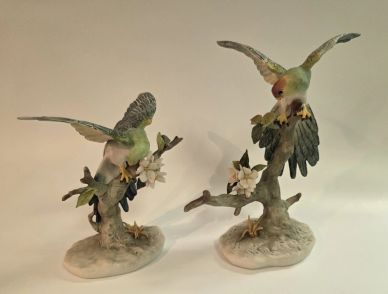
This is an eye catching set rarely seen with only a few having been produced. It's not known if they were introduced in the Spring or Fall of 1962. If available from Spring of '62 to the Fall of '65 the production would have lasted for about three years as lead time prior to release was several months. This allowed at least a few sets to be ready to ship as soon as the edition was announced and orders were received. If released in the Fall of '62 and closed at the beginning of '65 then production would have been around two years, which seems more likely. It's hard to believe these were not well received, which indicates something else lead to the short production run. Pricing seems to have been the issue. The set was expensive priced at $190 for an open edition. If orders failed to materialize, the set would have been retired. This pair is much smaller than expected. The amount of detail in the painted wings is extraordinary, thus the higher price.
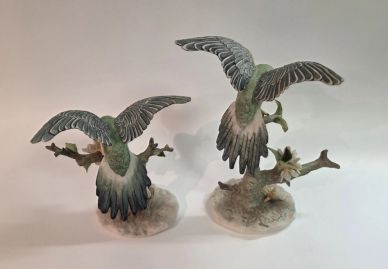
The official name assigned for these sculptures is Carolina Female Paroquet and Carolina Male Paroquet. Names were generally assigned during the development process. Nothing printed by the studio indicates why the French spelling for parakeet was used. While speculation some 65 years later is pointless, it is interesting. The French spelling of paroquet specifically refers to a type of parakeet and is an older less frequently used spelling. Today it's generally considered outdated. It may be that since the designation of "Carolina" was made for the type of parakeet, the spelling of paroquet was considered a suitable option.
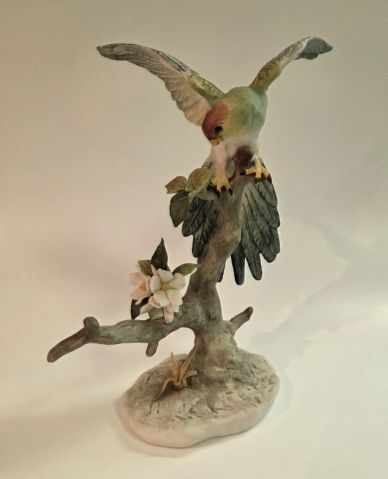
The male paroquet, shown above with his red head, is the taller of the two. While both have their wings spread and are approximately the same width, the female's stated measurement is 1 1/2" shorter. The measurements given are accurate as the set in this collection measures 8" for the male and 6 1/2" for the female.
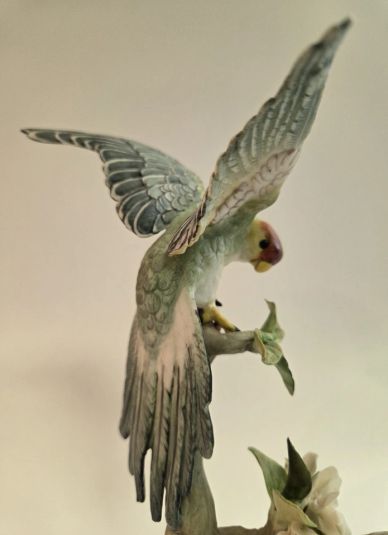
Most of the bird sculptures from this era were issued with or attached to wooden bases. The stated measurements given for each indicate no base was included in the height calculation. Unless a set is found with bases obviously issued from the studio, it's reasonable to assume this set was never sold with bases.
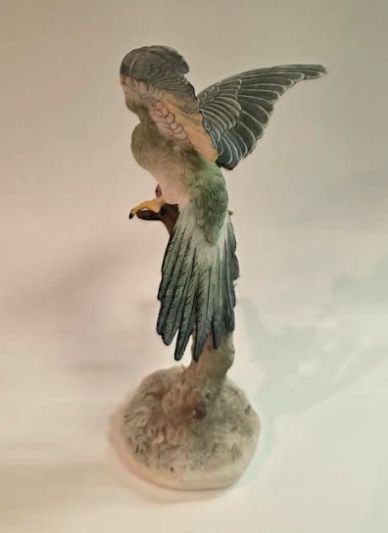
This set almost demands being displayed in front of a mirrored background so the backs can be seen.
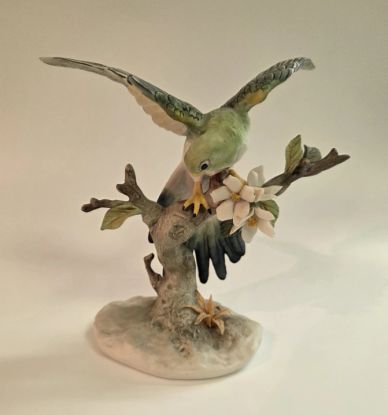
The famale bird was created with two branches. The studio didn't include the name of the unidentified flower in the paroquet's title. Each was individually hand-crafted of five petals adding to production costs.
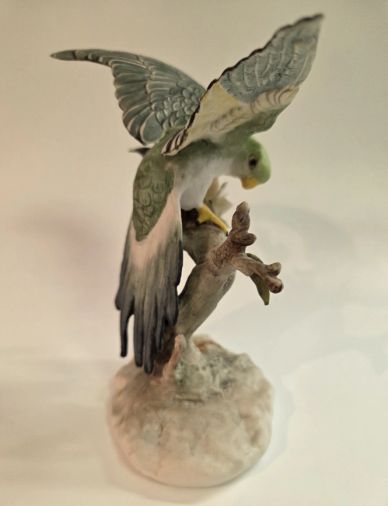
Once the color set has been seen it is difficult to conceive why a white set was available.
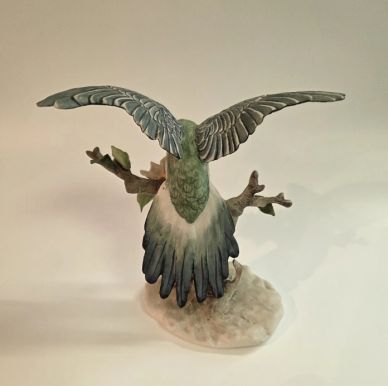
The female paroquet's body appears to be very similar to the male in design. Both have their wings spread and tails fanned.
Introduced in 1961 as a numbered limited edition of 200 pairs, the Gnatcatchers were completed in 1970.
Issue / Completed Price
$400 $400

All 200 pairs were completed. While it took nine years to finish the edition, it wasn't due to slow sales or orders failing to materialize. The edition became fully subscribed quickly. The hand formed flowers and leaves were labor intensive and took longer to create.

Official measurements were 6" tall by 10" in length. The taller sculpture (the male) measures 6 3/4" tall. This is likely due to the positioning of the bird and flowers on the tip of the branch. The permanently attached wooden base measures 10" long.
Both the male and female were attached to wooden bases. These should be handled gently as the sculptures can become loose and will rotate on the base.

The hand formed flowers and leaves are as delicate as they look. The individual stamen have been seen broken off on some pieces.
Many of the names of later sculptures were a combination of the name of the flower and the name of the bird, as in Wood Wren with Dogwood. With this pair, the studio never identified the flowers with the Gnatcatchers.

Variations have been noted. The prototypes used for marketing photos do have a few more leaves and flowers, particularly at the base of the female and on the horizontal stem on the branch of the male. While minor, these differences are easily seen. The changes were probably made prior to production to reduce some of the labor involved in producing the sculptures. While only a few dozen leaves per pair overall, it would have trimmed some effort from the production cycle. When comparing the 20+ sales on the secondary market recorded over the past 25 years, no design variations were found among production copies.
Over the course of the nine year production cycle a few minor color variations occurred. These mostly are seen in the color of the birds and the dark pink flower buds but intensity of color also varies between the light and dark green leaves. Much of this will be due to individual artist's style and techniques used when mixing and applying paint to the sculpture during the decorating process.

If the female Gnatcatcher looks familiar, it's because she first appeared on the 1956 Madonna with Bird. Clearly, it was assumed she looked enough like a Gnatcatcher she could be recycled for this pair of sculptures. The male may even have been created by modifying the tail, neck and head position just slightly so it wasn't obvious it was the same mold. It's possible the female was first introduced in the early 1950's and added to the Madonna in 1956. it won't be a surprise if one turns up at some point in the future.

The female made one final appearance in the Floral Bouquet of the United States where she was tucked in on the right side as shown.

Studio catalogs state the Golden Mallards and Teal Ducks were introduced as open editions in 1957 and closed in 1962. These dates are questionable. The book Cybis in Retrospect states the sculpture "Teal Ducks", design number 303T, was closed in 1960. No mention is made of the Golden Mallards. The two share design number 303 with a version indicator at the end (303T for Teal and 303M for Mallards). The dates of '57 to '62 are questionable for both versions. A letter from the studio to a merchant in response to a request for information in 1969, stated the Mallards were released in 1962 and completed in 1963. If the letter and entry in Retrospect are correct, then the Teal Ducks were introduced first with the Mallards having been introduced after the Teal version was retired. The dates of 1957-1962 may have later been meant to incorporate all items produced under design number 303. The Mallards may have been released and retired in 1962 with the final copies ordered being completed in early '63. These sculptures are rarely seen. Irony is not lost on the marketing photo showcasing two shotgun shells next to the Mallards. These would be the most expensive clay pigeons every sold, if that was the underlying message. It's likely the studio thought the added props might appeal to those who enjoyed the sport of duck hunting. If so, that was a total flop. The letter referenced earlier stated approximately 20 Mallards were produced. No mention is made of the "Teal Ducks". Retrospect further states the Teal Ducks were available in color and white. No mention of an all white Teal is made in later publications.
Issue / Completed Price
$125 $125
Once this sculpture is fully considered, it's soon realized there is more of the attached base than there is porcelain sculpture. Studio measurements given are 11". As a rule the size stated in marketing material is the height. The actual size of the piece in this collection is 8 1/2" tall by 14 1/2" wide on the base. The length of the porcelain base (atop the wooden base) is 11". It's probable the original measurement taken was the length of the porcelain base prior to a decision to add the wooden base. If the Teal Ducks were in fact sold and closed prior to the Mallards they may not have had a wooden base and the 11" length would be an accurate measurement. The Mallards are far heavier than expected due to the 2" tall solid wood base. There is a noticeable difference in the shape of the base on the piece in the marketing photo compared to production items. There are three documented sales on the secondary market. All three had bases like the base pictured above. Generally, the studio ordered custom sized bases to fit the shape of each sculpture. However, the way the porcelain sculpture sits on this base design, it does not appear to be a custom fit. It's uncomfortable, if not awkward. Pictures shown below illustrate this issue further.

The highly detailed decoration shown in the feathers on the back of each duck was time consuming to paint. The labor intensive process of finishing these mallards was slow and costly. It is possible the studio "retired" the sculpture and quit taking future orders when it was obvious they weren't quick to produce. It appears the studio retired the Teal Ducks in 1960 and recycled the sculpture with a new paint job and wooden base in 1962. Once the actual cost to produce was realized, the $125 price point was to low for desired profitability and the decision was made to retire and close the edition once all orders were filled.

No design or color variations have been documented among the three verified sales over the last 25 years. Some slight differences are noted in the positioning of the ducks but this it due to the mounting process in which the components were assembled.

The American Eagle (Pair) was released as an open edition set in 1954. First released in white, the color pair was released the following year in 1955. Both, the white and color versions were closed in 1960.
Issue / Completed Prices
$60 $60 (white)
$90 $90 (color)

During the 1950's the studio released a few sculptures as pairs. These pairs consisted of two identical items sold together. Candlesticks and three angel sets, the Guardian Angel, Angels in Adoration and Kneeling Angels were all sold as pairs. Due to losses over time most survive as single units today with their "mates" have been separated long ago.

Measurements for the eagle were given as 14" tall. Actual height is approximately 13 1/4". Variances are generally due to mold shrinkage over time with continued use. It's also possible the original measurement was taken from a prototype which was slightly taller. This piece is not mentioned as having, nor was it shown with a wooden base in any marketing material.

A marketing photo of the pair is shown above as it appeared in the book Cybis in Retrospect. The notation below the image states the eagle is from c. 1953.

The white, unpainted version shows the highly detailed work in the sculpture.

A striking contrast in fine porcelain the pair make a strong statement when displayed in any setting.


